

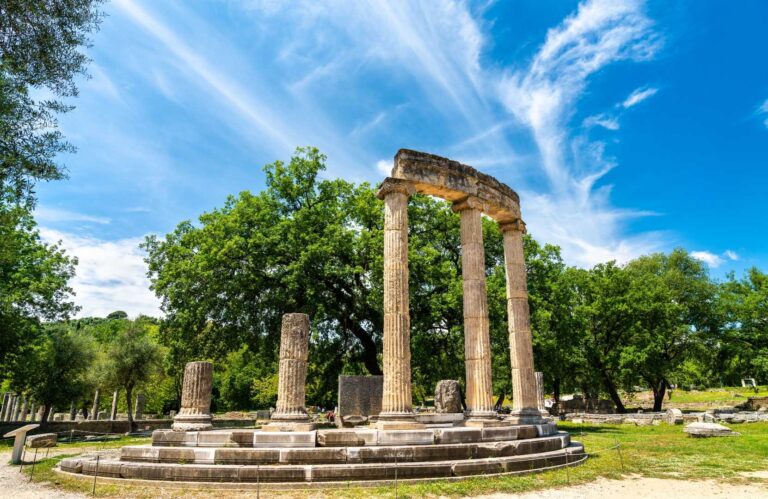
Ancient Olympia is one of the world’s largest and most historic archaeological sites. The sacred, tree-lined area of Altios, where the Olympic flame was lit every four years for over a thousand years, still exudes a serenity that the surrounding tourist infrastructure cannot completely extinguish.
If you’re staying in Costa Navarino, Kalamata or anywhere in Messinia, Olympia is within easy day trip distance. Here’s everything you need to know before you go.
The Journey from Costa Navarino
Distance: Approximately 95 km north. Travel time: 1.5 hours each way, mainly via the E55 national road from Kyparissia.
The drive north is worth a look in itself: after the olive groves and vineyards of Messinia, the road descends into the Alpheus Valley. The ancient site lies within this valley, green and wooded, recognisably the “sacred plain” described by ancient Greek writers.
Suggested departure time from Costa Navarino: 08:00–08:30.
The Two Parts of the Visit
A visit to Olympia is naturally divided into two parts: the Archaeological Museum and the Archaeological Site. Allow 4–5 hours in total for a proper visit.
The Archaeological Museum
Start here, before entering the site. The museum is one of the best archaeological museums in Greece and offers the necessary introduction to what you will see at the archaeological site.
Main exhibits:
- Nike of Paeonium — A 4th century BC statue of the goddess of victory, originally suspended above the Temple of Zeus on an 8-meter triangular pedestal. The original still bears traces of the gilding and coloring that ancient Greek statues had.
- Hermes of Praxiteles — Considered one of the best-preserved works of ancient Greek sculpture. The original marble, exhibited in the museum’s central hall, is astonishing for the smoothness and detail of the carving.
- Pedimentary Sculptures from the Temple of Zeus — The two triangular pedimentary ensembles depicting the struggle of Pelops and the Lapiths and Centaurs. Exhibited at ground level, their size and dynamic are impressive.
- The Bronze Helmet of Miltiades — The Athenian general who commanded at the Battle of Marathon (490 BC) dedicated his helmet here after the victory. It is exhibited with the dedicatory inscription still legible.
The Archaeological Site
The site covers approximately 700 meters and contains the monuments of the sacred complex, the educational spaces, and the supporting buildings of the ancient Games.
Temple of Zeus — The temple (5th century BC) was one of the Seven Wonders of the Ancient World, housing the colossal chrysanthemum and ivory statue of Zeus by Phidias. The statue has been lost, and the temple was destroyed by earthquakes in the 6th century AD. What remains are the huge inverted blue helmets — their scale, lying on the ground, gives a better sense of the original temple.
Heraion (Temple of Hera) — Older than the Temple of Zeus and better preserved in height, the Heraion is home to the base where Praxiteles’ Hermes originally stood. The lighting ceremony of the Olympic flame takes place here every four years.
The Ancient Olympic Stadium — A short walk through the arched entrance brings you to the track of the ancient stadium that held 40,000 spectators. The starting points are preserved in place at both ends. Standing here — on the actual surface, in the actual space — is a moment that most visitors find unexpectedly moving.
Pheidias’ Workshop — The building where the gold and ivory statue of Zeus was made has been excavated and identified. Its dimensions correspond exactly to the Temple of Zeus.
Practical Tips
- Visit the museum first. This sequence is strongly recommended and produces a better experience of the site. Understanding what you are looking at transforms the monuments into a coherent sacred landscape.
- Wear comfortable shoes. The site is large and the terrain uneven.
- Arrive before 10:00. Tour groups arrive late in the morning and move through the site in waves.
- Bring water. The site has limited shade.
- Allow time for the village of Olympia. The village next to the site has several good restaurants. Lunch here before returning is a natural end to the day.
Our Olympia Service
All day trips to Ancient Olympia include:
- Pick-up from Costa Navarino, Kalamata or any address in Messinia
- Comfortable vehicles
- Driver waiting during the visit
- Fixed pricing with no hidden fees
Frequently Asked Questions
How much do tickets to Ancient Olympia cost?
Entrance to the archaeological site and museum is covered by a single ticket. Tickets are purchased upon arrival and are not included in the transfer price.
Is Ancient Olympia suitable for young children?
Yes, although young children will not engage with the history as much as older ones. The open space and the stadium are naturally attractive to little ones. The museum requires a little more patience from children under 8.
Can we combine Olympia with another destination?
The most popular combination is Olympia plus the mountain villages on the way back. If there is time, an afternoon return via Andritsaina and the Temple of Apollo Epicurius (a UNESCO site rarely visited by tourists) adds only 1-2 hours.