

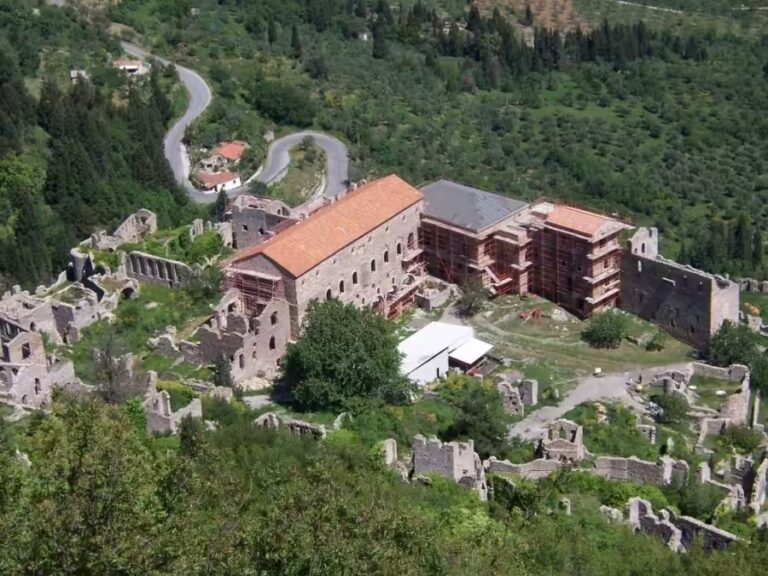
Mystras is a Byzantine city built on a steep slope, offering a panoramic view of the vast Evrotas valley and the peaks of Taygetos.
Mystras is a UNESCO World Heritage Site and one of the best preserved examples of late Byzantine civilization in the world.
What is Mystras?
Mystras was founded as a Frankish fortified city in 1249, fell to the Byzantines in 1262, who made it the capital of the Despotate of Mystras — essentially the last bastion of Byzantine culture in the years before Constantinople fell to the Ottomans in 1453.
During the 14th and 15th centuries, Mystras was a genuine cultural center. The philosopher Gemistos Plethon was here; scholars and artists fleeing the advancing Ottomans passed through Mystras before continuing on to Florence and Venice, bringing Byzantine thought to the Italian Renaissance.
The Area: What to See
The area is divided into three zones — Lower Town, Upper Town, and Castle.
Lower Town
The most accessible section and the most richly decorated.
- Metropolis (Cathedral of Saint Demetrius) — The oldest church in Mystras (founded 1262). The marble floor contains a double-headed eagle, the symbol of the last Byzantine emperors, marking the spot where Constantine XI Palaiologos — the last Byzantine emperor — was crowned in 1449.
- Monastery of Pantanassi — The only building in active use, home to a small community of monks who care for the church. Contains the best-preserved frescoes in Mystras — the Raising of Lazarus and the Entry into Jerusalem in the narthex are stunning examples of late Byzantine painting. The terrace outside has extensive views of the valley.
- Monastery of Perivleptou — Carved into the rocks, the small monastery church contains frescoes from around 1360 that represent the pinnacle of Byzantine artistic achievement. The Nativity, the Transfiguration, and the Assumption of the Virgin are technically and emotionally exquisite.
Upper Town
- Palace of the Despots — The ruined palace complex. Recent conservation work has stabilized the main hall (the Palace), which in its heyday was a throne room comparable to the finest in the Byzantine world.
- Church of Hagia Sophia — The palace chapel (14th century) preserves fragments of a marble floor and a frescoed ceiling. The view from the terrace — over the Lower Town, the valley, the mountains beyond — is among the best in the area.
- The Castle (Kastro)
The Frankish fortress at the top (240 meters above the valley floor) offers a 360-degree panoramic view that on clear days reaches as far as the Gulf of Laconia. The climb from the Upper Town takes about 20 minutes on a good path.
How to Get There from Costa Navarino
Distance: 100 km via the national road from Kalamata and Lagada. Travel time: 1.5 hours each way.
Lagada deserves its own mention. The road from Kalamata into the mountains behind the city climbs through a series of bends through a landscape of pine forest, rocks and deep gorges. The pass itself is at an altitude of about 1,500 meters. The descent eastward into the Evrotas Valley completes the feeling of crossing from one world to another.
Practical Details
Ticket: Single ticket. Purchased upon arrival.
What to wear: The site requires significant uphill walking on stone paths. Sturdy shoes are essential. In July–August, bring water and sun protection.
Photography: Photography restrictions may apply to the frescoes at Pantanassa Monastery and Perivlepto.
Monks at Pantanassa: The monastery is active. Modest attire is required (shoulders covered, no shorts).
Frequently Asked Questions
How long does it take to walk the entire site?
The full circuit from the lower entrance to the top and back takes about 2.5 to 3 hours at a leisurely pace. If you want to spend time on the frescoes (which reward slow observation), allow 3.5 to 4 hours.
Is Mystras worth the drive from Costa Navarino?
A definite yes — and that’s the answer from visitors who ask afterwards. The combination of Byzantine art, the natural setting, and the Langada route make this excursion one of the most complete experiences from Messinia.